Story
30 September 2026
Three women leaders on finding your voice and making space to lead
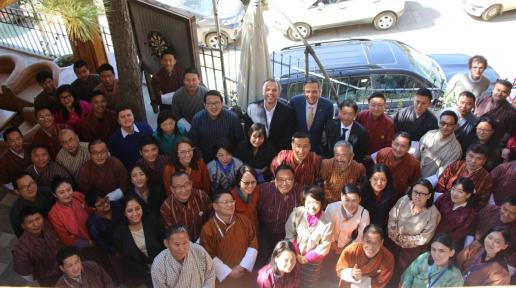
That question brought colleagues together over lunch on 30 September for a leadership conversation with three women leaders of the United Nations in Bhutan: Caitlin Wiesen, UNDP Resident Representative, Rushnan Murtaza, UNICEF Representative and Karma Tshering, UNFPA Officer-in-charge.The session was organized by the UNDP Ladies Café and the interagency UN Leave No One Behind (LNOB) Working Group. It was deliberately unlike a conventional panel. There were no presentations or polished success stories. Instead, the speakers reflected openly on career setbacks, confidence, visibility, balancing work and family, self-care and the sometimes-complicated experience of being a woman in leadership.For Caitlin Wiesen, she has never followed a linear path. She looked for chances to keep learning and for the place where her passions met her work. Her career took her across different roles and even outside the UN system before bringing her back. At one point, she took a job others saw as a less obvious career move, because it allowed her to work on an issue she cared deeply about.Her advice to the 25 young women at the UN present at this talk, was to follow issues you care deeply about, stay curious, connect with others, and recognize the value you bring from day one. “You don’t have to be in a position for years to have value. You have value coming in the door.”
-Caitlin Wiesen, UNDP Bhutan RepresentativeReflecting on her technical and management roles, including serving as Officer-in-Charge, Karma Tshering described leadership as a test of capability, resilience and trust. The experience also changed her perspective on the UN system, reinforcing the importance of working collectively across agencies.Her message to women considering leadership opportunities was not to wait until they feel perfectly qualified. Her message to women weighing leadership roles was to not wait until you feel perfectly qualified. “Women frequently hold themselves back from applying for senior roles until they feel completely over-qualified. You don’t have to do that. Trust your capacity to learn in the role, just as I am doing every single day.”
-Karma Tshering, UNFPA Officer-in-Charge Visibility was a recurring theme. The speakers noted that women often face different expectations when they speak up or seek opportunities, and that confidence can be read differently depending on who shows it. Karma described the narrow line women are expected to walk: assertive can be labelled aggressive, while holding back can be labelled submissive.Caitlin suggested making your work visible through writing and sharing ideas. Visibility, she said, doesn't have to mean being the loudest in the room.For Rushnan, the lesson came from experience. Looking back on her career, she remembers saying yes to every opportunity, regardless of how difficult or unfamiliar it seemed. Each new challenge became a chance to learn, grow, and discover that her own limitations were often self-imposed. She also learned an important lesson about women in leadership: women are often hesitant to ask for what they want; you have to raise your hand and ask for the opportunities you deserve. “Ask, ask, ask. There is a yes waiting for you after every nine no’s.”
-Rushnan Murtaza, UNICEF Bhutan RepresentativeShe encouraged colleagues to ask questions, seek feedback, and make their interests known. Difficult feedback, she added, can be more valuable than praise when it helps you grow.The conversation turned into realities of juggling multiple roles.For the speakers, leadership did not mean fitting into a single image of what a successful woman should look like.Rushnan spoke about navigating the many identities, expectations, and responsibilities that shape women’s lives. She encouraged women to celebrate their womanhood and embrace their leadership with confidence and pride. She emphasized the importance of women supporting and uplifting one another, noting that real progress happens when women champion other women. “When we support each other, open doors for one another, and celebrate each other’s successes, that is how we move women forward,” she said.Karma spoke about the importance of learning to prioritise oneself while also recognising that balancing professional and family responsibilities can sometimes require difficult choices.The discussion eventually arrived at a subject often left out of conversations about leadership: burnout and self-care.Caring for yourself, they said, is not separate from leading well. For Caitlin, it provides energy to support others. Karma urged colleagues to let go of guilt about taking time for themselves. Rushnan shared how walking, prayer and small routines help her step back from difficult moments.Above all, the speakers pointed to mentorship, community and relationships among women, and to the need for spaces where women can share experiences without having to prove themselves. Rushnan noted there is room for stronger, more intentional networks linking women leaders across the UN system, where people can share challenges and opportunities and learn together how to navigate organisations and careers. That is also part of what the Ladies Café aims to create: a space where women across UN offices can connect, reflect and learn from one another beyond their everyday work.The afternoon closed not with a formula for becoming a leader, but with an invitation to define leadership more broadly.Value yourself. Ask. Stay curious. Take the opportunity even if you do not meet every requirement. Learn from difficult feedback. Make yourself visible. And, perhaps most importantly, support the women coming after you.Because leadership is rarely a straight line.Sometimes, it begins simply by asking.
-Caitlin Wiesen, UNDP Bhutan RepresentativeReflecting on her technical and management roles, including serving as Officer-in-Charge, Karma Tshering described leadership as a test of capability, resilience and trust. The experience also changed her perspective on the UN system, reinforcing the importance of working collectively across agencies.Her message to women considering leadership opportunities was not to wait until they feel perfectly qualified. Her message to women weighing leadership roles was to not wait until you feel perfectly qualified. “Women frequently hold themselves back from applying for senior roles until they feel completely over-qualified. You don’t have to do that. Trust your capacity to learn in the role, just as I am doing every single day.”
-Karma Tshering, UNFPA Officer-in-Charge Visibility was a recurring theme. The speakers noted that women often face different expectations when they speak up or seek opportunities, and that confidence can be read differently depending on who shows it. Karma described the narrow line women are expected to walk: assertive can be labelled aggressive, while holding back can be labelled submissive.Caitlin suggested making your work visible through writing and sharing ideas. Visibility, she said, doesn't have to mean being the loudest in the room.For Rushnan, the lesson came from experience. Looking back on her career, she remembers saying yes to every opportunity, regardless of how difficult or unfamiliar it seemed. Each new challenge became a chance to learn, grow, and discover that her own limitations were often self-imposed. She also learned an important lesson about women in leadership: women are often hesitant to ask for what they want; you have to raise your hand and ask for the opportunities you deserve. “Ask, ask, ask. There is a yes waiting for you after every nine no’s.”
-Rushnan Murtaza, UNICEF Bhutan RepresentativeShe encouraged colleagues to ask questions, seek feedback, and make their interests known. Difficult feedback, she added, can be more valuable than praise when it helps you grow.The conversation turned into realities of juggling multiple roles.For the speakers, leadership did not mean fitting into a single image of what a successful woman should look like.Rushnan spoke about navigating the many identities, expectations, and responsibilities that shape women’s lives. She encouraged women to celebrate their womanhood and embrace their leadership with confidence and pride. She emphasized the importance of women supporting and uplifting one another, noting that real progress happens when women champion other women. “When we support each other, open doors for one another, and celebrate each other’s successes, that is how we move women forward,” she said.Karma spoke about the importance of learning to prioritise oneself while also recognising that balancing professional and family responsibilities can sometimes require difficult choices.The discussion eventually arrived at a subject often left out of conversations about leadership: burnout and self-care.Caring for yourself, they said, is not separate from leading well. For Caitlin, it provides energy to support others. Karma urged colleagues to let go of guilt about taking time for themselves. Rushnan shared how walking, prayer and small routines help her step back from difficult moments.Above all, the speakers pointed to mentorship, community and relationships among women, and to the need for spaces where women can share experiences without having to prove themselves. Rushnan noted there is room for stronger, more intentional networks linking women leaders across the UN system, where people can share challenges and opportunities and learn together how to navigate organisations and careers. That is also part of what the Ladies Café aims to create: a space where women across UN offices can connect, reflect and learn from one another beyond their everyday work.The afternoon closed not with a formula for becoming a leader, but with an invitation to define leadership more broadly.Value yourself. Ask. Stay curious. Take the opportunity even if you do not meet every requirement. Learn from difficult feedback. Make yourself visible. And, perhaps most importantly, support the women coming after you.Because leadership is rarely a straight line.Sometimes, it begins simply by asking.